Emotional Marketing for Architects
Why Your Content Sells Romance Instead of Results
By Bryon McCartney, CEO of Archmark
Read Time: 9 minutes
Some Quick Takes
- Architecture firms produce gorgeous content about the feeling of design, then wonder why prospects still haggle over fees.
- The problem isn't emotion. It's whose emotion. Many firms create content that is the architect's love story about architecture, but the client isn't in it.
- Positioning yourself as an artist makes your work a matter of taste. Taste gets debated. Clients pay for solutions to their problems.
- There's a way to keep the romance and still make the client the hero. It comes down to a simple change of camera angle, not a personality transplant.
Architecure Firm Marketing Isn’t Just About You and Your Firm
I fell down a rabbit hole this past weekend.
My feed kept showing me social media videos from a firm I had never heard of. An architect at a drafting table, leaning over some sketches. An architect seated in a Le Corbusier LC3 lounge chair. One explains that they started sketching houses at seven and never really stopped, and the other that there is a certain responsibility that comes with designing a building.
The production quality was very good. The quality lighting, framing, and audio indicated it was professionally produced. And the people on camera were sincere and obviously passionate about what they do. And you can't fake that.
So I watched a few of them.
Then something started to bother me. I needed to watch several more of these shorts before I could put a name to it.
The problem was that none of these videos was about the clients.
They were all about the architects.
There was no mention of a problem that was solved. Nothing about a budget that got protected. Or a zoning fight that got won, a difficult site that got tamed, or a family who finally stopped arguing about where the kitchen goes. Just videos about architects loving architecture, and zero about the people for whom the architecture is actually designed.
I want to be clear that this isn't a callout of one firm. That would be unfair, and it would also miss the point, because this is not one firm's mistake. This is the default setting for the entire profession. Scroll through fifty architecture firm feeds, and you'll find fifty variations of the same idea: the artist, the process, the material, the light.
Beautiful. Sincere. And almost completely disconnected from the reason anyone hires an architect.
I'm Not Anti-Romance When It Come to Architecture
Before this turns into the marketing guy telling architects to stop caring about beauty, let me plant a flag.
The romanticism is real, and it matters.
I've argued for years that emotion is the most underused asset in architecture marketing. When a client commissions a building, they are handing over their money, their timeline, and frequently their marriage-level stress tolerance to a stranger. That decision is not made on a spreadsheet. It's made in the gut, then justified with the spreadsheet afterward.
So no, the answer is not "be more corporate." The answer is not to replace the drafting table footage with a bar chart about project delivery efficiency.
Please don't do that.
The romance isn't the problem. The problem is that it's pointed in the wrong direction.

Whose Love Story Is This, Exactly?
Every story ever told has two roles that matter: a hero who wants something, and a guide who helps them get it.
That's the core of StoryBrand (Donald Miller's messaging framework, built on the narrative structure that shows up in basically every film you've ever loved). Luke has the destiny. Yoda has the wisdom. Katniss goes into the arena. Haymitch tells her how to survive it. Nobody buys a ticket to watch Yoda talk about how he got into the mentoring business.
If you want the full framework applied to a firm, I've written a StoryBrand guide specifically for architecture firms. But the short version is what matters here.
Architects, almost without exception, try to cast themselves as the heroes.
The sketching origin story, the material obsession, and don't forget the deeply felt and personal monologue about sustainability. Those are classic "hero-of-my-own-journey" moves. They are the architect's love story about architecture, filmed from inside the architect's own head.
Meanwhile, there's a person on the other end of that video who has their own love story running.
- She's been sketching floor plans on the back of envelopes for nine years.
- He's been renting a space that's slowly strangling his clinic and finally has the funds to build.
- They've inherited a lot with a slope nobody can figure out and a view worth fighting for.
They are the heroes of the only story they care about, and your firm's marketing rarely makes any mention of them.
Your prospect is not lying awake at 1:30 a.m. wondering what made you fall in love with architecture. They're lying awake wondering whether they can actually afford to do this, and whether the person they hire is going to make it better or worse.
But if you answer that, you're the guide. Better yet, you're their guide. But skip it, and you're a very talented stranger doing a "look at me" dog-and-pony show on the internet.

The hidden cost of being an artist
When you present yourself primarily as an artist, you make your work a matter of taste. And taste is, by definition, subjective. Which means the value of your work becomes subjective too.
Subjective value gets negotiated.
Art is only worth what someone will pay for it. Solutions are worth what the problem costs. Those are wildly different pricing conversations, and most firms are stuck having the first one while wishing they were having the second.
Watch how this plays out in the fee conversation. A prospect who understands you as an artist hears your number and thinks, "that seems like a lot for drawings." A prospect who understands you as the person who prevents a $400,000 mistake on a difficult site hears the same number and thinks about the $400,000.
Same number. Completely different reaction. The only variable is what they think they're buying. (I've written more about how to communicate your value and raise your fees if that's the conversation you're stuck in right now.)
This is also, I'd argue, the origin of the free work epidemic in the profession. When your value rests on taste, the only way to prove your value is to demonstrate taste. So you produce concepts on spec, you sketch a few "quick ideas" to show what you'd bring, and you hope the taste closes the deal. (Sometimes it does, but at a discount, and after you've already given away the thing you were supposed to sell. There's a whole pattern here where being too helpful actually costs you clients.)
And then there's the differentiation problem, which is the one that really stings.
When you and two other firms in your market all produce beautiful content about light, material, and process, none of you has differentiated from anything. You've each just described architecture. To the homeowner or business owner comparing your three proposals, you're three flavors of the same product, and the only remaining tiebreaker is price. That's usually the real reason firms lose clients to competitors they consider less qualified.
That's commodity positioning 101 (which is marketing-speak for when a buyer can't tell the difference between options, so they default to whoever's cheapest). That isn't what you intended, but it happened anyway. One romantic studio video at a time. Fixing it is less about visual identity than most firms assume, which is why our eight steps to architecture firm branding start with what you stand for rather than what you look like.
And this isn't only a social media problem. We've tested more than 10,000 architecture firm websites over the past ten years, and the pattern I keep seeing has nothing to do with design or load speed. The site never names a problem the visitor recognizes as their own.
The numbers back up how little most firms say. In our study of 2,305 architecture firm websites with BQE CORE, the median homepage carried about 160 words of text, and 87% had fewer than 500. A quarter had fewer than 50 words. Most firms aren't losing to better content. They're losing to the handful of firms that said anything at all.
There's one more cost, and it's sneaky. Romance content is extremely appealing to other architects. It gets likes, it gets shares, it gets warm comments from your peers who understand exactly what you mean about the light. Your most engaged audience quietly becomes people who will never, ever hire you.
Lovely for the ego. Rough on the pipeline.

Three Questions to Audit Your Architecture Firm's Marketing
You don't need an agency to diagnose this. You need about ten minutes and a willingness to be slightly annoyed with yourself.
Pull up the last five things your firm posted on social media, then ask:
Who is the subject of the sentences?
Count the "we," "I," "our firm," and "our process" against the "you," "your," and "your project." If the first pile is taller, you're the hero of your own marketing. This is the single fastest tell, and almost nobody checks it.
Is there an honest client problem anywhere?
A real one. Named, specific, slightly uncomfortable. Not "we believe good design improves lives," which is the architectural equivalent of saying you're against crime. Something like "most people don't discover their lot has a drainage problem until after they've paid for a foundation." If there's no problem in the content, there's no reason for the content.
What is the viewer supposed to do next?
The answer here is not "engage with the brand." What are they supposed to do? What is the next step? Watching a beautiful video and feeling something is not an action. If the honest answer is "keep scrolling," then that's exactly what happens, which is why the content feels good and produces nothing.
Most firms fail all three. That's not a character flaw, but it is what happens when nobody ever taught you the difference between expressing yourself and positioning yourself.
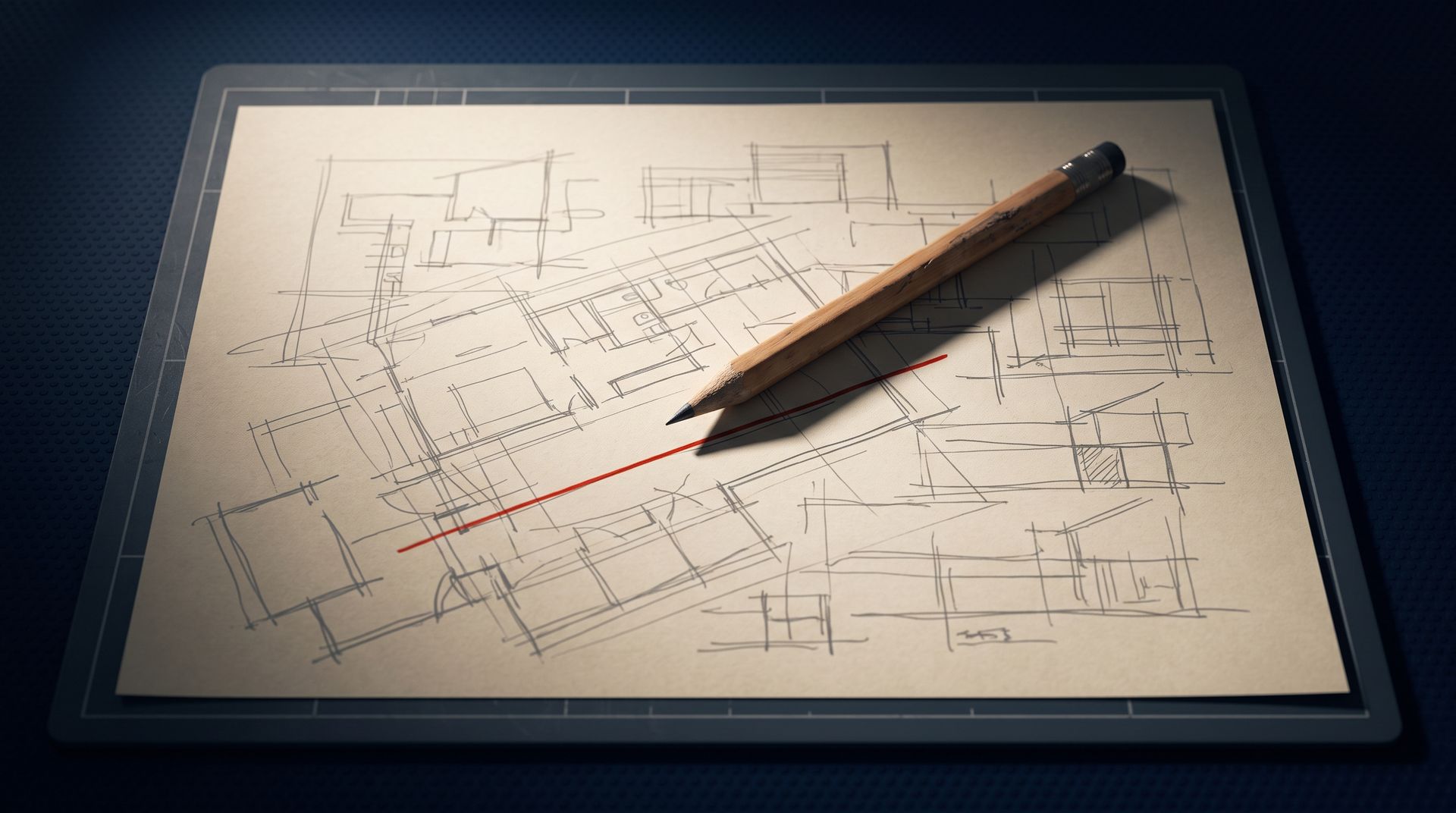
Same love story, different camera angle
This is the part that makes the whole fix easier than it sounds.
You don't have to throw out a single one of your stories. You have to move the camera.
Take the sketching origin story, the one where you've been drawing houses since you were seven. There are two ways to tell it.
Version one, as identity
"I've been sketching since I was seven years old. There's nothing like the moment pencil hits paper and a space starts to appear."
Lovely. True. Completely about you.
Version two, as evidence
"Before we draw a single wall in the computer, I sketch it by hand. Slowly. It drives some clients crazy at first, because it looks like we're moving too slowly. But a sketch costs an hour. A change order costs twelve thousand dollars. And people can actually react to a sketch. Nobody knows how to tell you a rendering feels wrong, but everyone can point at a pencil line and say, 'not that.'"
Same fact. Same love. Same forty years of devotion to the craft.
The first version is a self-portrait. The second is a reason to trust you, and it happens to reveal exactly as much about who you are.
That's the whole move. Take the thing you love, and attach it to something the client is afraid of. The material obsession becomes a story about maintenance costs in twenty years. The sustainability conviction becomes a story about a client's utility bill in year fifteen. The passion for the site walk becomes the reason you caught something the surveyor missed.
Your romance stays fully intact. It just starts doing a job.
What changes when you get this right
I'm not going to pretend this is a magic switch. But the shift is real, and it shows up in ways that are hard to miss.
The first conversations get shorter and better.
When prospects arrive already understanding what problem you solve, you skip the twenty minutes of explaining what an architect does. They come in pre-sold on the category and asking about you specifically.
The fee conversation stops being an argument.
Not because your number gets smaller, but because the number now sits next to a cost. When somebody understands what the problem is worth, your fee stops being an expense and starts being math.
The wrong people stop calling.
This one feels like a loss for about a month, until you realize how much of your week was going to conversations that were never going to close. Clear positioning is a filter that works while you're asleep.
And you stop performing.
This is the one I'd want most, if I were you. There's a particular exhaustion that comes from producing content that feels like an audition, week after week, with no way to tell if it's working. Content built around a real problem gives you a scoreboard. You know whether it landed because people respond to it with their own version of the problem.
Picture a prospect on your first call saying, "the video where you talked about how nobody finds out about the drainage until after the foundation, that's literally us, that's why I'm calling."
That is a completely different meeting than "I saw your work, it's beautiful, can you send over your fee structure."
You get to stay an architect
I want to be careful here, because this is where most marketing advice loses architects entirely.
Nothing in this asks you to become a marketer. Nothing here asks you to stop being an artist, tone down your work, or start talking like a management consultant with a hard hat.
Architecture is a business that solves expensive, high-stakes, deeply personal problems for people. It's also an art. Those two things have never been in conflict, and the profession's long habit of pretending otherwise has cost it a fortune in fees, respect, and leverage.
The best-positioned firms I know are also the most romantic about their work. They've just learned to aim it outward.
That's most of what we do at Archmark, honestly. Our ClearStory process exists because architects almost always have the right raw material and the wrong point of view on it. The stories are there. The convictions are there. Somebody just has to turn the camera around.
Back to the drafting table
Which brings me back to those videos.
I don't think that firm should stop making them. The instinct is right, the sincerity is real, and they clearly have something to say.
I just wish somebody would walk into frame and say: "Here's who we made this for, and here's what they were afraid of before we started."
That video would take the same afternoon to shoot. It would cost the same amount. And it would be the only one on the whole feed that a prospective client actually recognized themselves in.
If you're looking at your own marketing and getting an uncomfortable feeling that it's a very beautiful self-portrait, that's a solvable problem, and usually faster than you'd think.
We run a small number of Clarity Calls each month. No pitch deck, no obligation, just a conversation about where your firm is stuck and whether there's a straightforward path out. We'll look at your last five pieces of content together and find the ones that are already halfway to being about your client. You can apply by clicking here.
Bring the sketching story. We'll figure out who it's really for.
Questions I Hear a Lot
Should architecture firms stop making emotional content about design?
No. Emotion is what drives the decision to hire an architect, and firms that strip it out end up sounding like engineering vendors. The fix is directional. Aim the emotion at what the client feels about their project, not at what you feel about the profession. A story about a client's fear is still an emotional story, and it converts far better than a story about your love of materials.
What's the difference between being the hero and being the guide in marketing?
The hero is the one with the problem and the goal. The guide is the one with the experience and the plan. In your marketing, the client should always be the hero, because that's the story they're living. Your job is to demonstrate that you've helped people like them get where they're trying to go. It's a positioning choice, not a modesty exercise, and guides are the ones who get paid.
Why do architecture fees feel so expensive to clients?
Usually because they don't understand what they're buying. When a firm markets itself primarily on aesthetics and process, the client evaluates the fee against drawings, which feel abstract and overpriced. When a firm markets itself on the problems it prevents and the outcomes it delivers, the client evaluates the fee against the cost of getting it wrong. Same fee, entirely different conversation.
What should an architecture firm post on social media instead of studio content?
Post the client's problem. Specific, recognizable situations your ideal clients are living through right now: the site condition nobody expects, the budget mistake that shows up in month four, the decision people regret two years after move-in. You can still film it at the drafting table with the good lighting. Just make sure someone other than you is in the story. If you want a starting list, we've collected 15 social media ideas for architects that follow this principle.
Does talking about the business side make a firm seem less creative?
The opposite, in practice. Firms that clearly articulate the problems they solve tend to attract clients who trust them more and second-guess them less, which produces more creative freedom, not less. The firms that seem most precious about their artistry are frequently the ones getting design-by-committee'd to death, because they never established the authority that lets them lead.
Bryon McCartney is the CEO of Archmark and a certified Business Made Simple, Hero on a Mission, Small Business Flight School, StoryBrand, and Unreasonable Hospitality Coach. He's helped 5,000+ architecture firms move beyond hope marketing to build systematic client acquisition processes that actually work.