
Marketing for Architects: Why Programs Fail & What Actually Works
The Real Reason Marketing Didn't Work for Your Architecture Firm
TL;DR
- Marketing programs don't fail because the strategies are bad—they fail because architects don't fully engage with the process
- The difference between architects who transform their firms and those who stay stuck is always participation, not the quality of the marketing strategy
- You can't build a successful architecture firm marketing system by hoping it works while you ignore it—transformation requires active engagement
- Mike Sweebe went from 5% to 40% conversion rate by fully participating: showing up to calls, doing homework, sharing truth, and trusting the process
- Before investing in any marketing program, ask yourself: Am I willing to give as much as I'm expecting to get?
You've been here before.
You signed up for the marketing program, the coaching cohort, the course that was going to finally fix your firm's business development problem. You paid the fee (ouch), cleared your calendar for the kickoff call (double ouch), and listened to the pitch about transformation and growth and consistent revenue.
Three months later? You're in the same place. Maybe worse, because now you're out the investment and still fielding calls from tire-kickers asking if you "do residential" while your ideal commercial clients are hiring your competitors.
So you blame the program. Of course you do. It didn't work. The promises were empty. The strategies were too generic. The coach didn't understand architecture. Whatever the reason, you're done with that and back to referrals and crossed fingers.
But here's the truth nobody wants to hear (including me, by the way - I've been on both sides of this):
The program probably wasn't broken. You were.
Not "broken" like defective. Broken like a bone that hasn't healed right because you kept using it before it was ready. Broken like a process that got interrupted before it could work.
You didn't show up. You didn't do the work. You didn't engage.
And before you close this tab in righteous anger, let me tell you why this is actually the best news you'll hear all week. Because if the program was genuinely broken, you'd be out of options.
But if you were the problem?
That's fixable.

The Uncomfortable Pattern Nobody Talks About
Why Architects Specifically Struggle With This
Let me be clear: This isn't unique to architects. Every industry has people who buy solutions and then don't implement them. But architects? You have some specific challenges that make showing up and engaging even harder than it is for, say, accountants or consultants or literally anyone else.
First, you're already drowning. You got into architecture to design buildings, not to manage projects or chase invoices or figure out why your Google Business Profile isn't showing up in searches. You definitely didn't get a degree in architecture to become an SEO expert or optimize LinkedIn profiles. You're already working 60-hour weeks trying to keep projects moving, keep clients happy, and keep your team from imploding. Adding "homework from marketing program" to that list feels impossible.
Second, you want a passive solution. You secretly (or not so secretly) hope that marketing can work like good mechanical systems - set it up once, let it run in the background, maybe do some preventive maintenance once a quarter. The idea that marketing requires your active participation, your voice, your willingness to be vulnerable about your firm's challenges? That's not what you signed up for.
Third, you're protective of your firm's image. Sharing what's really happening in your business (the projects you lost, the clients who ghosted you, the proposals that went nowhere, the fact that you're not sure how you're going to make payroll in three months if you don't land something soon) feels like admitting failure. Especially in an industry that values polish and perfection and those gorgeous portfolio shots where every corner detail is immaculate.
So when your marketing coach asks, "What happened with that commercial developer lead?" you say, "Oh, it didn't work out" instead of "I spent three hours on a proposal for a project they'd already awarded to someone else because I was desperate and didn't ask the right qualification questions."
One of those responses leads to growth. The other keeps you stuck.
What Full Engagement Actually Looks Like
Let me tell you about Mike Sweebe.
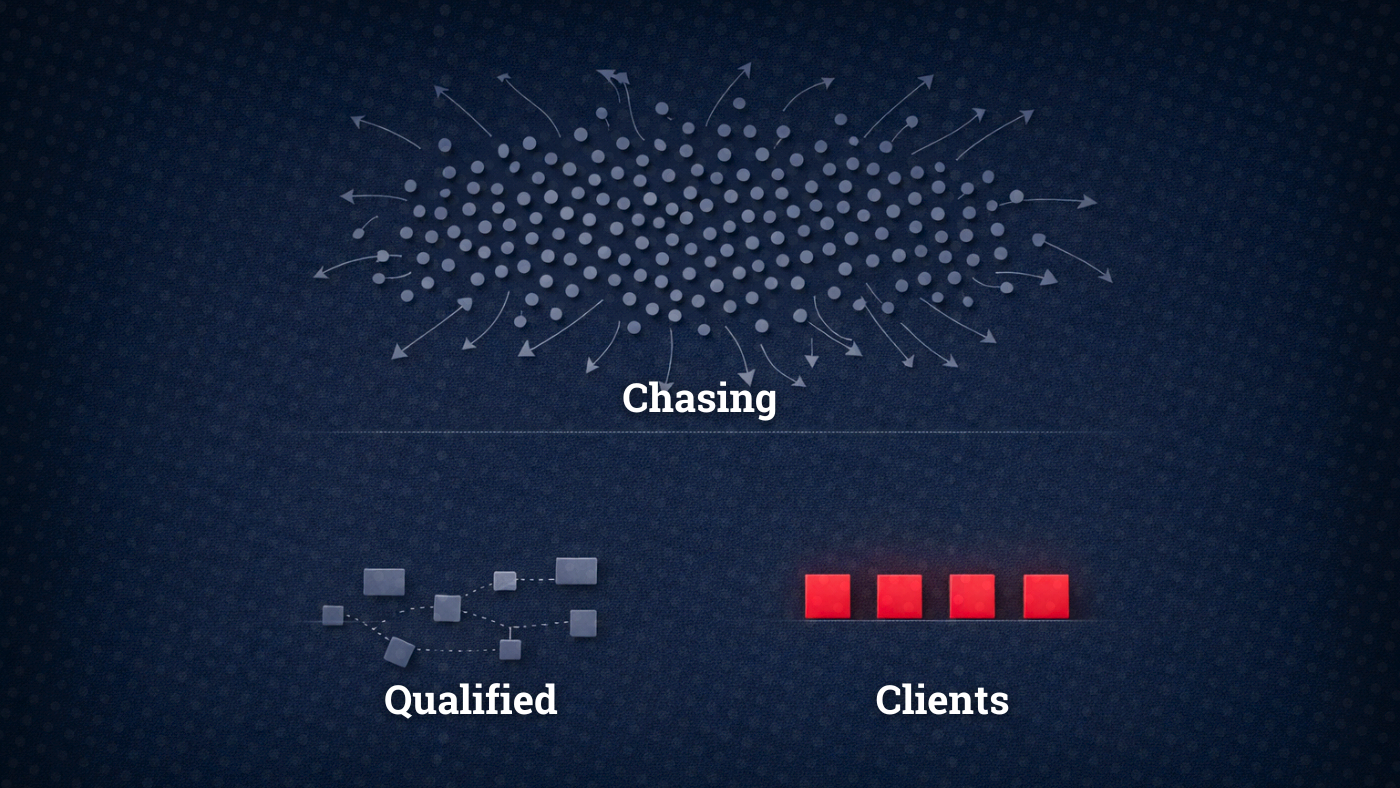
Mike runs a residential architecture firm. When he came to us, he was doing what most architects do: chasing every lead that came through. Every phone call, every web form, every referral from a past client's cousin's neighbor. He was spending 30-60 minutes per lead trying to figure out if they were serious, what they wanted, whether they had a budget, whether they understood what architects actually do.
He was chasing over 100 leads. Only about 10 were actually qualified. Only 5 became clients.
Do the math: that's roughly 50-100 hours of lead chasing for 5 clients. And during that time, he couldn't focus on design, couldn't lead his team, couldn't do the work he actually loved and was good at.
Mike committed to our program. And I don't mean he signed the contract and paid the invoice - everyone does that. I mean he actually committed.
He showed up to every call. He worked on every homework assignment. He engaged and shared his ideas (and his failures). When we asked what was happening in his business, he told us the truth instead of giving us the polished version.
We created a lead capture form for his website - a simple qualification tool that asked the questions he was spending an hour on the phone trying to figure out. We set up his phone system so unrecognized numbers went to voicemail with a message directing them to the form.
Mike went from chasing 100+ leads (90% unqualified) to receiving about 50 qualified leads. Twenty of those became clients.
Read that again. From 5 clients to 20 clients. From a 5% conversion rate to a 40% conversion rate. From spending 30-60 minutes per lead to having a form do the qualification work for him.
And the best part? The leads that made it through the form were already pre-qualified. They had budgets. They understood timelines. They valued design. They weren't looking for the cheapest option or comparing him to their brother-in-law who "does CAD."
Mike got his time back. He got his sanity back. He got to be an architect again instead of a desperate salesperson.
Here's what made it work: Mike did the work. He didn't just sit back and hope the form would magically appear. He reviewed the questions we drafted. He tested the system. He trusted the process even when it felt counterintuitive to "turn away" leads by making them fill out a form. In short, he engaged.

What Non-Engagement Looks Like (And Why It Kills Programs)
The Participation Principle (That Applies to Everything)
- You get better feedback.
If you share what's really happening, your coach can help you with the actual problem instead of the sanitized version you're comfortable admitting. When Mike told us he was spending up to an hour per lead trying to qualify people, we could create a specific solution. We could focus our marketing efforts on attracting qualified prospects instead of chasing tire-kickers. If he'd just said "lead gen could be better," we would've given him generic advice that wouldn't have moved the needle.
- You build momentum.
Every small win compounds. Every homework assignment completed makes the next one easier. Every call you show up to fully prepared creates more progress than three calls you attend while distracted and unprepared.
- You create accountability.
When you engage publicly (even if "publicly" just means within your coach or cohort), you're more likely to follow through. Nobody wants to show up to a call and admit they didn't do any of the work. Again.
- You get clarity faster.
The questions you ask, the struggles you share, the "I tried this and here's what happened" reports - those create real-time learning that no pre-packaged curriculum can match. Your specific challenges become case studies that help everyone in the group, including you.
- You actually transform. Because transformation doesn't happen in consumption. It happens in application. You can read every marketing book ever written (please don't), but until you actually implement something, test it, refine it based on real results, you're just accumulating theoretical knowledge that does exactly nothing for your firm's revenue.

What You Should Expect (From Your Program and From Yourself)
If you're investing in a coaching program - ours or anyone else's - here's what you should expect from them:
A clear framework and proven marketing strategies for architects. They should be able to show you what works, why it works, and how it applies to your specific situation. No vague "personal branding" nonsense or "just post more on Instagram" advice.
Expert guidance and feedback. They should review your work, give you specific input, and help you refine your approach based on what's actually happening in your firm.
Real support and accountability. They should show up prepared, hold you to your commitments, and care enough to call you out when you're phoning it in.
But here's what you should expect from yourself:
- Show up. To every call. Prepared. Present. Not multitasking, not "quickly checking email," not letting your project manager interrupt every 10 minutes.
- Do the homework. All of it. Even the assignments that feel tedious or unnecessary. (Spoiler: they're not unnecessary. That's why they're assigned.)
- Share the truth. About what's working, what's not, what you tried, what you're afraid of, what you don't understand. The messy, imperfect, real truth.
- Review the work. When your program creates deliverables - messaging, copy, systems, frameworks - actually review them. Thoughtfully. Ask questions. Implement them. Test them. Report back on what happened.
- Focus on the strategy. Yes, tactics matter. But if you're spending more time debating font choices than you are clarifying your positioning, you're avoiding the real work.
- Trust the process. Especially when it feels uncomfortable or counterintuitive. Mike's instinct was to answer every phone call immediately because he was afraid of missing an opportunity. Sending people to voicemail felt wrong. Until it resulted in 4x more clients with a fraction of the effort.
The Vision: What's Possible When You Actually Engage
Here's what changes when you fully participate in a structured coaching or marketing program:
Your revenue becomes predictable. Not perfectly predictable (this isn't manufacturing widgets), but you can actually forecast with some confidence instead of just hoping the phone rings.
Your new clients get better. Because you're attracting people who are already qualified, already aligned with your values and approach, already understand what you do and why it matters.
Your time gets freed up. You're not chasing unqualified leads or explaining your process 47 times to people who are never going to hire you anyway. You're actually doing architecture.
Your confidence increases. Because you have a system that works. You know what to say, how to say it, where to find your ideal clients, and how to convert them into projects. You're not winging it or hoping or relying purely on referrals.
Your firm becomes valuable. Not just in theory (a firm that depends entirely on the owner's relationships and hustle has limited value) but in practice. A firm with systems, with consistent lead flow, with a clear market position - that's a firm that could scale or sell or sustain itself if you decide to step back.
And here's the best part: You get to be an architect again. You're not spending half your time on business development desperation. You're not anxiously checking your bank account wondering if you can make payroll. You're not taking projects you don't want because you're afraid nothing better is coming.
You're designing. You're solving problems. You're doing the work you trained for years to do.
But only if you show up and do the work that makes that possible.

The Real Question
So here's what I need you to ask yourself:
Are you actually ready to participate?
Not "are you ready to invest in a program" (anyone with a credit card can do that). Not "are you ready to consume more content about marketing" (you've probably already done that and it hasn't helped).
Are you ready to show up, do the homework, share the truth, review the work, and trust the process even when it's uncomfortable?
If the answer is no - if you're hoping for a passive solution that works while you ignore it - then don't waste your money. I mean that sincerely. Keep doing what you're doing, accept the feast-or-famine cycles, and stop pretending you want something different.
But if the answer is yes - if you're genuinely ready to give as much as you're expecting to get - then the transformation is actually possible.
Mike Sweebe's story isn't unique. It's repeatable. The framework works. The strategies work. The systems work.
But only if you work them.
What This Means for You (And Us)
FAQ: Making Marketing Programs Actually Work for Your Architecture Firm
Why do marketing programs fail for architecture firms?
Most marketing programs don't fail because the strategies are bad - they fail because architects don't fully engage with the process. Between juggling projects, managing teams, and trying to actually practice architecture, many firm owners treat marketing programs as something that should work passively in the background. But effective architecture firm marketing requires active participation: showing up to calls, completing assignments, sharing real challenges (not just the polished version), and implementing the systems that get created. Without that engagement, even the best marketing strategies for architects won't produce results.
How much time should I expect to invest in a marketing program?
In the first three months, expect weekly calls plus homework assignments - typically 3-5 hours per week total. This is when you're building the foundation: clarifying your positioning, identifying your ideal clients, creating lead generation systems, and developing your messaging. After that initial phase, most programs shift to monthly check-ins with ongoing implementation work. Yes, it's a significant time investment when you're already working 60-hour weeks. But consider this: if you're currently spending 30-60 minutes per unqualified prospect (like Mike Sweebe was doing with 100+ leads), you're already investing that time - just not strategically.
What's the difference between architects who succeed with marketing and those who don't?
The architects who transform their firms do three things consistently: First, they show up prepared and engaged - not multitasking or distracted. Second, they share what's actually happening in their business, including failures and uncomfortable truths, so their coach can help with real problems instead of sanitized versions. Third, they implement the work - they don't just review the new website copy or newsletter sequences and say "looks good," they actually put systems into practice, test them, and report back on results. The ones who struggle skip homework, focus on inconsequential details (fonts instead of positioning), and hope the program works while they ignore it.
How do I know if I'm ready to invest in a marketing program?
Ask yourself: Am I willing to give as much as I'm expecting to get? If you're hoping for a passive solution that runs in the background like mechanical systems, you're not ready. If you think you can pay someone to "handle your marketing" while you focus solely on design, you're not ready. But if you're genuinely willing to participate - to show up, do homework, share truth, review work, and trust the process even when it's uncomfortable - then you're ready. The program is the framework and strategy, but your participation is what actually builds the structure. Without your engagement, nothing gets built.
How long does it take to see results after clarifying my message?
It varies, but you'll typically see shifts pretty quickly. Barron Schimberg landed his largest project ever (a $13 million Humane Society building) just two weeks after we rebuilt his LinkedIn presence with clear messaging. Roderick Anderson at SARCO saw a 191% increase in website traffic within 90 days, plus 21 new keyword rankings. But here's what's more important than speed: quality. You might not get more leads immediately, but the leads you do get will be dramatically better fits—which means higher conversion rates, less wasted time, and more enjoyable projects. That shift often happens within the first few months.
What should I expect from a good architecture marketing program?
A quality program should provide three things: First, a clear framework and proven marketing strategies for architects - not generic "post more on LinkedIn" advice, but specific approaches that work for architecture practices. Second, expert guidance and feedback on your specific situation - reviewing your work, helping you refine your approach based on what's actually happening in your firm. Third, real accountability - someone who shows up prepared, holds you to commitments, and cares enough to call you out when you're phoning it in. But equally important is what you should expect from yourself: showing up prepared, doing all assignments, sharing the messy truth about your business, and focusing on strategy over tactics.
Ready to stop making excuses and start making progress? Apply for your free Clarity Call and let's figure out how to make your firm the obvious choice for your ideal clients.
Bryon McCartney is the CEO of Archmark and a certified Business Made Simple, Hero on a Mission, Small Business Flight School, StoryBrand, and Unreasonable Hospitality Coach. He's helped 5,000+ architecture firms move beyond hope marketing to build systematic client acquisition processes that actually work.